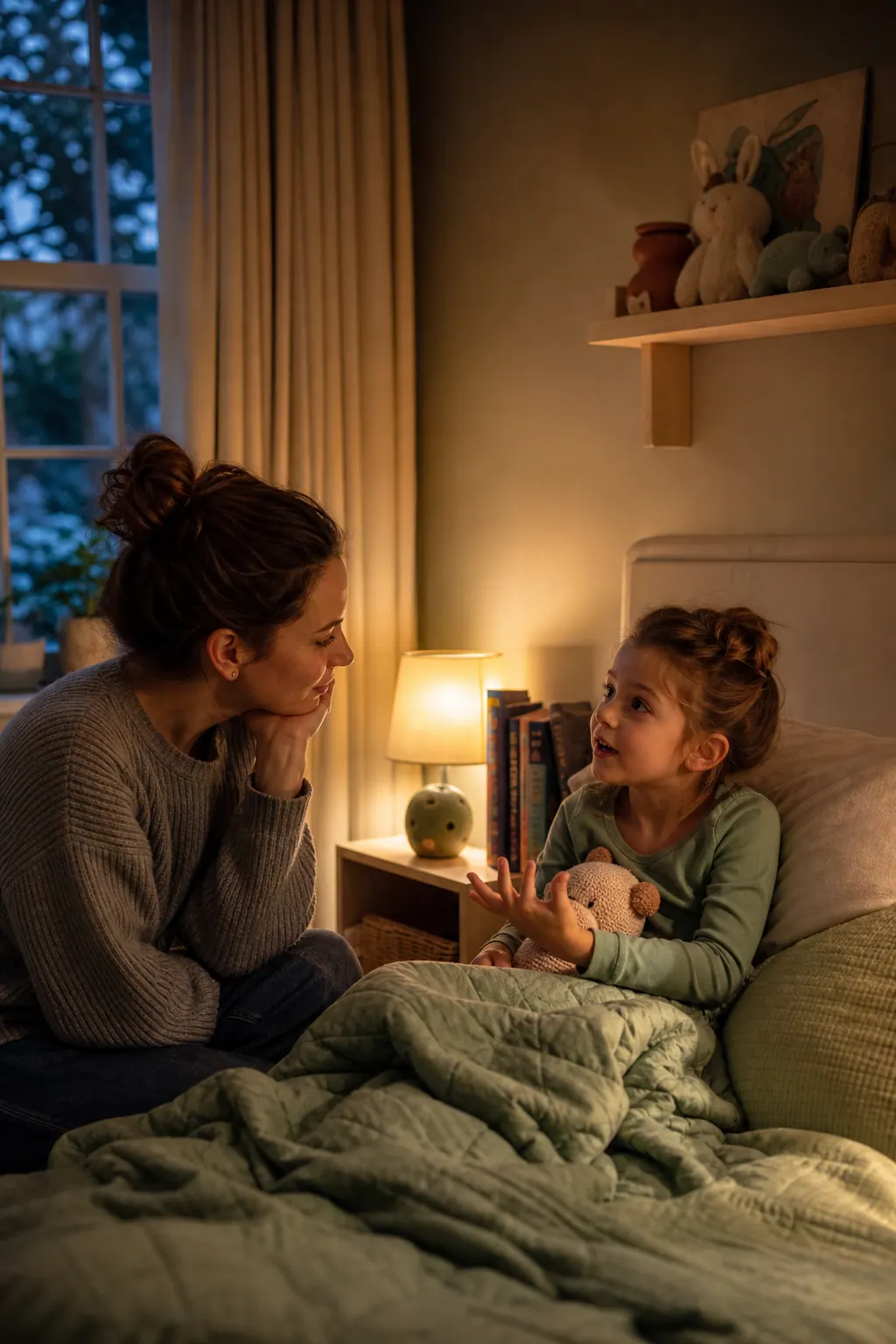
When strange words need calm answers
A reader once passed along a list of unsettling things children had reportedly said to their parents. The examples were memorable. Some were funny in a nervous-laugh sort of way. Some sounded like tiny horror stories told in a cereal-bowl voice. What stood out most, though, was not the strangeness of the lines. It was the missing half of the conversation.
What is a parent supposed to say next? A startled adult can easily turn a child's odd sentence into a family emergency. Yet many of these moments are better understood as young language, big feelings, imagination, testing, imitation, or a child trying to describe something with a vocabulary that is still under construction.
Before looking at examples, clear one idea out of the way: creepy is an adult judgment. It tells us what the grown-up felt. It does not necessarily tell us what the child meant. When parents react as if the child has done something wrong simply by speaking, children may learn to hide their thoughts instead of bringing them to a safe adult.
1. The bedtime goodbye
Imagine tucking a two-year-old into bed and hearing, "Goodbye, Dad," instead of the usual good night. When corrected, the child insists that this time it really is goodbye. That line can make an exhausted parent check the bedroom three times before midnight.
A useful response stays simple: "Goodbye for tonight. I will see you in the morning. I love you." At two, words are still loose tools. Goodbye may mean the same thing as good night, see you later, or the end of this part of the day. Do not load it with an adult understanding of death or danger.
2. The new baby is not welcome
A preschooler studies a newborn sibling, turns to a parent, and announces that the baby looks like a monster and should be put back in the ground. The sentence is shocking because adults hear threat. The child may be expressing jealousy, confusion, disgust, fear, or simple protest about a changed family order.
Try: "You are not sure you like having the baby here yet. Tell me more." This response acknowledges the feeling without approving harm. It also gathers information. A child who can talk about resentment is less likely to need behavior to communicate it.
3. The skin comment at sunrise
Few things wake a person faster than a small face inches away whispering about removing your skin. It sounds awful. It may also come from seeing sunburn peel, hearing a strange phrase, wondering what bodies are made of, or discovering that powerful words get a powerful reaction.
Humor can soften the moment: "Oh no, I need my skin today." Curiosity can help too: "What do you think skin does for us?" Either route keeps connection intact. What does not help is shaming the child for a sentence they may not fully understand.
4. The threat disguised as dating advice
Ask a seven-year-old how to get someone to be your girlfriend and you may receive a wildly inappropriate strategy involving threats. This does not mean the child is destined for cruelty. It means the child has a primitive idea of power and is trying it out in speech.
Keep the answer short and thoughtful: "Do you think threats help people want to be close to you?" Or, "I have not seen that work well. What is another way to show someone you like them?" A question makes the child think. A lecture often makes the child disappear behind a blank stare.
5. The dramatic picture in a child's mind
A child staring into space may report imagining a wave of blood washing over them. The adult body wants to flinch. The better parental move is to find out whether this is a story, a dream, something seen on a screen, a metaphor, or a genuine worry.
"That is a very strong picture. Tell me about it." This keeps the door open. Avoid disgusted responses. Children who are met with disgust often stop sharing the very material adults most need to understand.
6. Wanting to keep a parent forever
A child says they want to preserve a parent in a giant glass jar after death so they can keep looking at them forever. A sibling may immediately puncture the moment by pointing out the jar would need to be enormous.
First hear the love inside the odd package: "You wish I could always be close. That is a loving thought." If a sibling mocks the younger child, address that separately: "We can add ideas without putting someone down." The goal is to protect tenderness while still teaching respectful speech.
7. A story from before birth
Some children speak as if they remember another family, another mother, a car accident, or a life before this one. Families will interpret those statements differently depending on belief, culture, and comfort level.
You do not have to prove or disprove the story in the moment. A grounded answer is: "That sounds like something that feels very old in your mind." Whether it is imagination, dream material, overheard language, or something more mysterious, the child benefits from being heard without being argued out of their own experience.
8. The season of bathroom jokes
Around preschool age, many children discover that body words can transform an ordinary room into a laughing room. A nonsensical joke involving bottoms, plugs, noodles, or other odd combinations may sound crude to adults and completely brilliant to the child.
Meet silliness with proportion. "That is a very silly joke." Then move on. Bathroom humor grows when it becomes forbidden treasure. It usually shrinks when adults neither reward it with outrage nor treat it as a moral crisis.
9. Word play that sounds darker than it is
Toddlers repeat sounds. "Hi" can become "die" because mouths experiment before meaning catches up. The adult hears danger; the child may be enjoying rhyme, rhythm, and the delicious discovery that sounds can change.
Turn it into language play: "Hi, die, fly, bye. Listen to all those rhymes." You have shifted the moment from fear into literacy. Later, you can play the same game with cat, hat, bat, and mat.
10. Promising not to chew bones
A cuddly child solemnly promises never to chew on a parent's bones. Strange? Yes. Dangerous? Probably not. The phrase may come from dogs, cartoons, Halloween decorations, idioms like being chewed out, or a child's attempt at reassurance.
"Good. I am glad to hear that," is enough. Not every odd sentence deserves an interview. Some phrases vanish faster when adults do not build a stage around them.
11. Love expressed as possession
A child may say, in effect, "I love you so much I want to carry your head around so I can always see your face." Adults hear violence. The child may be reaching for an image of closeness and choosing the most literal, least socially polished version available.
Translate the affection: "You really like having me near you. Here is a better way to keep me close." Then offer a hug, a photo, a bedtime note, or a small ritual. Teach a warmer expression without rejecting the attachment underneath.
12. Learning how fragile babies are
A child holding an infant might ask whether they are allowed to throw the baby into the fire. It is a sentence that needs immediate clarity, not adult panic. The child may be checking a rule, repeating something dramatic, or trying to understand what "gentle" means.
Say plainly: "No. That would hurt the baby. This is how we hold him. These are gentle hands." Then demonstrate. Children need concrete instruction more than horrified faces.
13. A frightening bath-time story
Sometimes a child makes a casual remark about private body parts, someone trying to get in, fighting back, dying, or now being here. Because the topic touches safety, the parent should stay calm while paying attention.
A balanced answer might be: "You are here with us now, and our job is to keep your body safe and healthy. You can always tell us if someone touches you or scares you." Keep the present secure. If a statement raises a real safety concern, follow up gently, document what was said, and seek professional guidance without interrogating the child.
The larger lesson
Refuse to make a child's strange sentence into the child's identity. Children say awkward, intense, funny, alarming, and beautiful things because they are practicing language in public. The adult's job is to listen for the feeling under the words, respond without ridicule, and guide the child toward safer, kinder, clearer expression.